


Free Shipping on Most Orders Within the Continental U.S. (Excludes AK/HI)
30-Day Returns
Secure Checkout on Every Order
Specs-First Selection: Every Lock Listed by Verified Ratings and Materials
Built for Smarter Living
At Think Smart Products, every device is selected for the precision of its engineering — the grade of its housing, the layers of its access control, the reliability of its connectivity. We stand behind what we carry with straightforward 30-day returns and free shipping on most orders within the Continental U.S. Questions? Reach us directly at support@ThinkSmartProducts.com.
Questions We Get a Lot About Smart Locks
IP55 means the housing is tested to resist dust ingress and low-pressure water jets from any direction — the second digit, 5, covers rain, hose splash, and weather-driven moisture. A lock without a published IP rating gives you no verified baseline for outdoor exposure. For exterior doors or covered entryways with indirect weather contact, an IP54 or IP55 rating is the minimum specification worth installing.
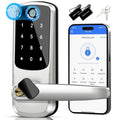
Layered access redundancy means the lock is engineered with multiple independent credential methods — fingerprint, keypad code, RFID card, Bluetooth app, and in some units a physical key cylinder — so that a dead battery, lost phone, or failed sensor does not lock out the user. A lock with only one access method transfers all failure risk to that single point. Redundant access layers exist specifically to prevent that single-point failure from becoming a lockout.
SUS is the Japanese Industrial Standard designation for stainless steel grades — in door hardware it most commonly refers to SUS304, an austenitic alloy with a chromium-nickel composition that resists oxidation, surface pitting, and galvanic corrosion without a painted or plated finish. Zinc alloy housings can be machined to close tolerances but depend on a surface coating for corrosion resistance; once that coating is breached, the substrate degrades. For exterior applications or high-humidity climates, SUS construction eliminates the coating-breach failure mode entirely.
Think Smart Products offers 30-Day Returns — full details are available in our Return Policy. Before purchasing, confirm your door's backset measurement, bore diameter, and panel thickness against the lock's listed specifications; most smart locks in this collection publish those dimensions in the product details. If there is a fit conflict, the return window gives you time to verify against your actual door.
About Our Smart Locks
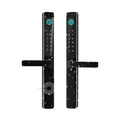
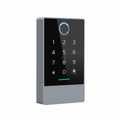
A smart lock replaces or augments the mechanical cylinder with one or more electronic credential systems — fingerprint biometrics, capacitive keypads, RFID card readers, Bluetooth proximity, or cloud-connected app control — while retaining the structural duty of a deadbolt or latch assembly. The category exists to solve a specific problem: mechanical keys are a single-point credential with no audit trail, no remote management, and no fallback when lost. Smart locks address each of those gaps in hardware. When evaluating a unit, the variables that matter are ingress protection rating for the installation environment, housing material for the exterior climate, access method count for redundancy planning, and connectivity protocol for integration with existing automation systems. A lock rated for outdoor exposure will carry a published IP rating; one without that rating is unverified for weather contact regardless of marketing language. Backset compatibility, bore diameter, and panel thickness tolerance are mechanical prerequisites that must be confirmed against the door before purchase. The right smart lock is the one whose specifications match the door, the environment, and the access workflow it will be asked to manage every day.